


Swiftynomics w/ Misty Heggeness
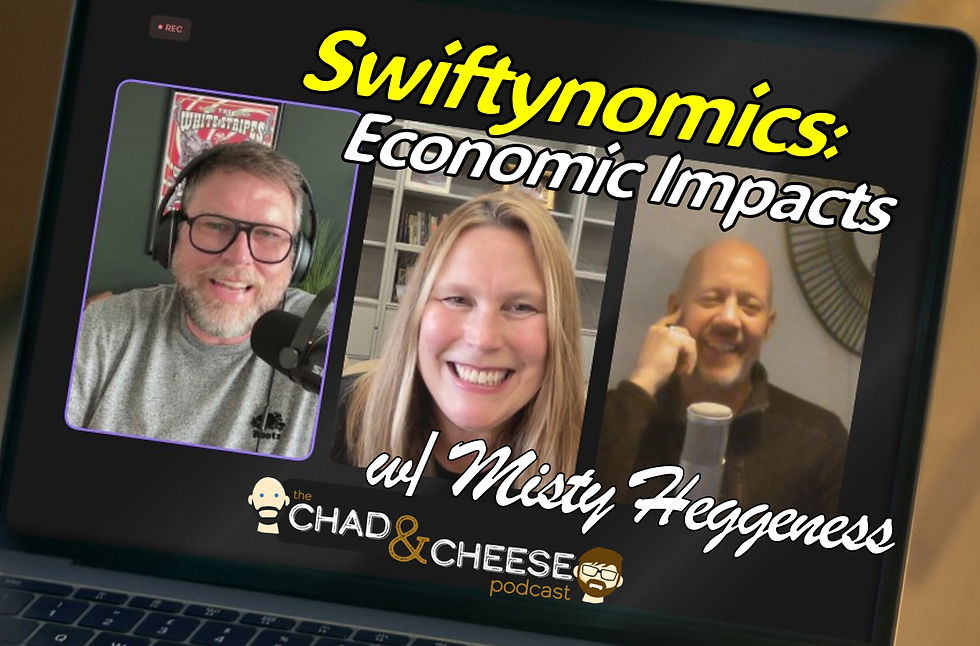
Welcome to HR’s Most Dangerous Podcast… where economists quote Taylor Swift, Joel tries to stay relevant, and Chad just learned the Census Bureau runs on caffeine and existential dread.
This episode features economist and author Misty Heggeness talking Swift, systems, and why the “old boys club” might be sweating more than they admit. From pandemic wine-writing sessions to billion-dollar tour economics, we unpack how women are reshaping work, leadership, and the economy—whether corporate America is ready or not.
Highlights:
A Norwegian ancestor burned at the stake… and that’s just the intro
Taylor Swift: pop star or economic masterclass?
Census Bureau life: numbers, Chipotle, and constitutional obligations
Why women aren’t waiting for the top—they’re building new pyramids
Trickle-down economics vs. pay-your-people economics
AI, bias, and why your PowerPoint might be the real winner
Snark level: high.
Economic insights: surprisingly legit.
Joel references Swift lyrics: against his will.
PODCAST TRANSCRIPTION
Joel Cheesman (00:31.083)
Yeah, old enough to know better, still too young to care. What's up everybody? It is the Chad and Cheese podcast. I'm your cohost, Joel Cheeseman. Joined as always, Chad Sowash's riding shotgun as we welcome Misty Heggeness, former principal economist and senior advisor at the US Census Bureau and author of her first book, Swift Dynamics, How Women Mastermind and Refine Our Economy. Misty, welcome to HR's Most Dangerous Podcast.
Chad Sowash (00:34.634)
to care.
Chad Sowash (00:40.554)
Hello.
Misty Heggeness (01:00.728)
Thank you for having me, excited to be here.
Joel Cheesman (01:03.285)
excited to have you. There's a lot in your your CV. Let's let's hear about you. What did we miss? Tell us about you like what makes you tick. Give us an intro into Misty.
Misty Heggeness (01:15.382)
Yeah. So I'll start by saying I'm from originally from Fargo, North Dakota, where, know, we rode in covered wagons, up until the year 2000. I love the movie. love the the accent is yes, it's spot on. I have an interesting story about that, but I was away from my family for a year, watched the movie and then my grandmother and my mother came to visit me and my grandmother had exact.
Joel Cheesman (01:26.133)
Do you like the movie or is it kind of a slap? okay. Did they get it right? Did they get the accents and the...
Misty Heggeness (01:43.814)
the accent from the movie. Yeah, it was pretty funny. So yes, I'm from Fargo, you know, went to school at the University of Minnesota. I guess the other interesting thing about me is one of my ancestors was the second to last Norwegian woman burned at the stake in 1670. I don't know what else I can tell you.
Chad Sowash (02:03.0)
hello. Yeah. Okay.
Joel Cheesman (02:07.445)
How do you know that?
Misty Heggeness (02:10.028)
Well, I mean, if you have lore like that in your family, it's passed down generation to generation.
Joel Cheesman (02:13.213)
my god.
Chad Sowash (02:15.316)
Wow! Burnt at the steak!
Joel Cheesman (02:16.743)
Okay. And that's our show everybody. It's only downhill from here. Thanks for tuning. Thanks for tuning in. All right. What? You top that. Yeah. She's, yeah. She's going to top that. I don't know. What else you got Misty? What else should we know?
Chad Sowash (02:25.216)
No, we still got to talk about the Census Bureau, I mean, come on.
Misty Heggeness (02:31.918)
Sorry, I worked for the federal government for 12 years, career staffer, nerdy, statistician, economist at the Census Bureau. Now I'm at the University of Kansas as a professor of public affairs and economics.
Chad Sowash (02:47.232)
Hello. So talk a little bit about the US Census Bureau. That sounds like a rock and roll kind of gig. mean, really? Come on.
Misty Heggeness (02:51.182)
it is. mean, you know, you can't get better.
Joel Cheesman (02:56.587)
What's the drug of choice to get through a day at the US Census Bureau? Is it caffeine, obviously?
Misty Heggeness (03:02.296)
So let's see, the drug of choice would be, you know, numbers, numbers, and more.
Chad Sowash (03:04.17)
Caffeine, cocaine.
Joel Cheesman (03:08.779)
Chipotle. Wow.
Misty Heggeness (03:11.958)
yeah, well, you know, we, the census Bureau counts all the people, so never underestimate the power of the census Bureau. every 10 years we go, how about the people? Yeah. Yeah. So, you know, it's, a very important, important place. Actually it exists because of an amendment in the constitution. So, obligated by a super law to count all the people.
Joel Cheesman (03:20.619)
Immigration a common topic on this show, so.
Joel Cheesman (03:41.291)
All right, let's pivot before we put everybody to sleep. You've written your first book. What was the inspiration? Why this topic? Talk us through it.
Misty Heggeness (03:42.926)
Hahaha!
Chad Sowash (03:43.71)
Thank you.
Misty Heggeness (03:47.404)
Yes.
Misty Heggeness (03:52.238)
So I am what I consider a pandemic author. So when everyone was sitting in our, you know, we're sitting in our houses during the pandemic and in our pajamas drinking, you know, day drinking wine, trying to just survive.
Chad Sowash (04:07.71)
Did you have a camera in my house?
Misty Heggeness (04:10.99)
Yes, because I worked for the Census Bureau at the time. But yeah, so I just, I started really hyper focusing on what was going on with women at work and specifically with mothers and work, because I was a mother of a 10 and 12 year old at the time. And I just found that I really, really enjoyed writing blogs and writing pieces for general audience about economics and about, I don't know if you hear the
Chad Sowash (04:14.378)
That's a point. Yeah. Government.
Misty Heggeness (04:39.904)
University of
Chad Sowash (04:43.232)
I just did, yes.
Joel Cheesman (04:44.619)
What what all right what is that top of the out? does that ring for what is that blow for?
Misty Heggeness (04:48.374)
No, that means class is either ending or starting. So every day, every 50 minutes, we get a steam whistle.
Joel Cheesman (04:53.611)
Okay.
Chad Sowash (04:59.348)
That sounds great.
Joel Cheesman (05:00.169)
Why steam whistle not like a chirp? Cause Jayhawks.
Misty Heggeness (05:03.188)
It's, yeah, no, it's old school. Scare the crap out of you if you don't know what's coming.
Joel Cheesman (05:08.753)
Okay, okay. Little University of Kansas tidbit, everybody.
Chad Sowash (05:10.506)
All right.
Misty Heggeness (05:12.778)
Yes. So anyway, so I just found that I really enjoyed writing. And so I wanted to write a book about the modern woman because I think a lot of the ways that we think about women today in the news media and others just doesn't really fit what's happening with women today. So I decided to write a book. And yeah, I'm happy to tell you why I call it Swiftynomics and what it has to do with Taylor Swift.
Joel Cheesman (05:35.317)
Please do. Go ahead. Yeah, we don't have to set you up. Why Swift Dynamics?
Chad Sowash (05:36.606)
Yeah? Hit it!
Misty Heggeness (05:39.95)
Yeah, so let me start with it was the year 2019 and I was working at a nerdy statistical agency in the federal government called the US Census Bureau. And I happened to come across a music video for the song, The Man, which is a part of Taylor's Lover album. And if you have either of you seen this music video? Homework, you've got some homework after this podcast.
Chad Sowash (05:46.08)
Mm-hmm.
Chad Sowash (06:02.784)
I have not, no.
Joel Cheesman (06:03.721)
No.
Misty Heggeness (06:07.71)
So, you know, free online on YouTube, go watch it. It is so incredible. And watch to the very end because there's a nice little surprise after the credits. But I over identified with that music video and the song. And I had been working around a lot of older, you know, white men, nerdy statisticians. And I just over identified with that song. So I just started following Taylor's career.
Joel Cheesman (06:31.125)
So assuming a lot of our listeners haven't heard this song, give us sort of the cliff notes. Is the man bad? Is that kind of the gist?
Misty Heggeness (06:35.744)
Yeah, the man, it's basically Taylor writes lyrics about how there's extra struggles for women trying to exist in a man's world because, you know, either we have to work harder or we have to be more strategic in order to get forward and in order to advance. so and, know, at the time I had had I was working in like a management leadership position as a senior advisor and
Chad Sowash (06:37.568)
Chad Sowash (06:46.494)
Mm-hmm.
Misty Heggeness (07:03.266)
I would ask somebody to do something and they would get upset because they didn't want to do it. And they would run and go and complain to my boss, who at the time was the chief scientist of the organization. And I had male colleagues next to me who we would have conversations of like, if you had asked somebody to do that, there's no way they would run and tell our boss. And so just like all of the kind of weird dynamics that exist when you're female and you want to lead things. And so I just.
Chad Sowash (07:21.76)
I
Chad Sowash (07:30.43)
Was that the moment you became a Taylor Swift fan? you? Okay. Okay. That's important. Yeah.
Misty Heggeness (07:33.634)
That was the moment I became a Taylor Swift fan for sure. Yeah. Yeah. So I didn't know. I mean, I didn't follow any of her earlier, younger career or anything like that. And then during the pandemic, she came out with two albums and I was just so amazed. I'm an economist by training. I study a lot of labor and work and productivity. And I was just so amazed that she was so productive during the pandemic to
push out two albums while the rest of us, like I said, I was sitting on my couch in my pajamas, day drinking wine, trying to survive to the next day. so, yeah. And so I just really watched how she evolved in her career, some of the moves that she did to get around obstacles and just became really impressed with her. And so I decided she would be a perfect muse for the book. And here we are.
Chad Sowash (08:08.928)
Eatin' cream, yeah, I know, yeah.
Joel Cheesman (08:26.795)
I'm not a Taylor fan. Hello. My wife has seen her in concert and loves her. So I do know a little bit agentically about her. She, she bought her songs back. Correct. Correct me if I'm wrong in any of this, but she bought her songs back, which was from a man, I believe, or at least a man run company. So did that happen before or like your, your sort of inspiration? Was it during that process that she sort of took
Misty Heggeness (08:40.428)
Yes. Yes.
Misty Heggeness (08:44.6)
Yep. Well.
Joel Cheesman (08:55.157)
took her life back? Because I think there was a real metaphor of sort of that happening and her taking it back and re-recording everything. Did that impact sort of how you felt about her and what she stood for?
Misty Heggeness (08:59.981)
Yeah.
Misty Heggeness (09:06.476)
Well, I mean, here's what I'll say. I started under contract to write this book before the Arrows tour came out, before she bought back her albums. So I was a fan before any of this stuff. And she just keeps on giving me like awesome content, you know, wrap into the book. She's like the gift that keeps on giving. But, you know, it's true. She, you know, had this experience where her first six albums were sold out from under her. She argues in the public
Chad Sowash (09:14.111)
Yeah.
Joel Cheesman (09:18.911)
Okay.
Chad Sowash (09:21.984)
That's awesome. Yeah.
Misty Heggeness (09:36.303)
sphere that nobody asked her about, nobody gave her the opportunity to purchase them herself. And essentially she did the Eros tour, she became a billionaire, she got enough money, she sent her mom and her brother to the company that, Scooter Braun who bought them originally and then he sold them off to a different company. And she sent her mom and brother to this company.
to basically say, would you sell these back to Taylor? And because it has family and sentimental value, and they negotiated with this company and the company agreed to sell her back her albums. And it's pretty amazing. in the meantime, she rerecorded four or five of those six albums and put them out. so, yeah, Taylor's versions. And so it's basically like,
Chad Sowash (10:26.1)
Yeah. Taylor's versions, right? Yeah.
Misty Heggeness (10:32.884)
know, Taylor's a millennial, so she's got all of these people. And I'll focus on women who grew up with her. She would write songs at, you know, the age at which she was at, which resonated with a lot of millennials. And then she put out all these Reve-Chorus, and now all the children of these millennial women, you know, have become fans of her younger version music. So it's just a big cycle, like the way that she has...
Her business tactics, whether intentional or not, are just phenomenal.
Chad Sowash (11:03.584)
Well, let's talk a little bit about the economic impact because like Joel's wife, my wife and my oldest, they actually went to Wembley during one of those eight sold out shows and it generated an estimated 300 million of capital. Nearly 700,000 fans attended, driving up for the hotel occupancy, like almost to 100%.
Misty Heggeness (11:16.3)
Yeah, I did too.
Chad Sowash (11:31.584)
uh, increasing local hospitality spending, contributing to the broader one buh buh buh billion dollars of impact in the UK. So when I saw that, I mean, I, I, I mean, I always thought she was great. I just wasn't a big fan of her music, but as I was started to see what she was doing from an, from a business standpoint, from an economic standpoint, I thought, wow, she is a
powerhouse. So can you talk a little bit about that from an economic standpoint, being able to literally go into a local community like a London or Lisbon and really make an impact on that on that local economy.
Misty Heggeness (12:15.96)
Yeah, and even in the US, she was in London, I think, four or five nights. And that's like $320 million as estimated generation of local impact on local businesses. So if I'm going to tell you the story about the economics of Taylor Swift, we need to start at the beginning. And so when Taylor was a teenager,
Chad Sowash (12:39.562)
Please.
Misty Heggeness (12:44.362)
knew she wanted to write music and she knew she wanted to sing music. And she was lucky enough to be in a family where they were able to, you know, provide resources for her to kind of go to Nashville and try to get into country music. Taylor wanted to country, she wanted to write country music songs for other teenage girls. And just to be more specific, probably other white teenage girls like Taylor herself.
Chad Sowash (13:08.896)
Mm-hmm.
Misty Heggeness (13:08.942)
And country music executives in Nashville at the time said, gee, thanks, but no thanks. We don't think there's any market in, you know, in teenage girls as a consumer of country music. And, and, you know, she started on a contract with RCA as a develop, a development contract, which means that, you know, they were just going to develop her, but not produce any of her music. She broke. That was 14. She was 14.
Chad Sowash (13:30.826)
She was like 14, wasn't she? Yeah, yeah.
Misty Heggeness (13:34.317)
And she broke that contract and she moved into, she took a risk, which is she broke that contract because A, she wanted to sing her own music that she was writing and she knew RCA wouldn't let her or, you know, wouldn't support that. And B, they were doing developmental and she didn't want to wait. And so she broke that contract and she went with Scott Borsha, Borshada, can't remember exactly his last name, Scott B, we'll call him Scott B. And Scott.
had just left a big major music company as an executive and was starting his own company. He said to Taylor, she was the big one that he signed, and he said, if you sign with me, I will let you record your own music that you write and I will let you produce albums now. And so she agreed to do that. And he was OK with her writing music about teenage girls in a country genre. And the one thing that I say about this is that wasn't
economically strategic or business strategic for Taylor at the time, but boy was it. She knew that there was a market where there was a gap. And I'm sure that those country music executives who didn't see the value in writing country music songs for teenage girls really are kicking themselves right now or kicked themselves because that's a part of her success story is she
Chad Sowash (14:47.264)
You
Misty Heggeness (15:01.614)
really focused in on being authentic with herself. And she happened to fall at a time, know, millennials are really a community where, you know, girls and boys were grew up with their parents telling them, you can be anything, you can do anything, you know, go to college and girls were going to college not to find a partner to marry, but were going to college because they had career aspirations and, you know, wanted to start careers. So,
Joel Cheesman (15:27.53)
Mm-hmm.
Misty Heggeness (15:30.264)
Taylor grew up with this generation that had just this vision of economic independence and a lot more disposable income in their 20s. you know, they were less likely, it became very expensive for women, for millennial women to get married and have kids because they were getting careers, not jobs. Their incomes were higher because of their education. And so...
Taylor really tapped into a group that historically had been somewhat overlooked by the music industry and she's just been riding the waves with it ever since.
Joel Cheesman (16:01.451)
Misty.
Chad Sowash (16:01.832)
Isn't that amazing though? I mean, because you're talking about an industry that is a machine and you would think that they understand demographics and the next demographic that was actually coming up that they had to target, but they didn't understand that. Yet this 14 year old girl who was on her way up, I mean, she nailed it. It means it's a tale as old as time, right? But this corporate machine just couldn't get it.
so I guess at the end of the day, from an economic standpoint, obviously it worked out for her.
Misty Heggeness (16:38.39)
Yeah, I mean, it worked out for her and like she's not the only woman to do this. there, you know, the other people I think about is like Reese Witherspoon. You know, she is known for Legally Blonde. She has some type of public speech where she, you know, is saying, Hollywood is really off key because, you know, they only
portray women in roles that say, my, what can I do? And she's like, how many of your brothers or your sisters and moms do you know that when they come across a problem say, my, what can I do? And Reese went off and started her own production company because she saw that Hollywood executives were continually bypassing stories that had like deep, rich content about the lived experiences of women. And so there's a handful of women today who have had a lot of success.
by really tapping into stories about the authentic lives of women at a time when women's income is going up, et cetera, et cetera.
Joel Cheesman (17:32.363)
Misty went.
I'm curious, you started the book around the start of COVID or the pandemic and what a turbulent sort of time in so many ways. You had the Me Too movement, you had Black Lives Matter. Suddenly white men were the bad guys in everything. we've, don't know, 180 might be too extreme, we've sort of, the pendulum has sort of gone back. I'm curious the world from your perspective from when you started the book, do you feel like that women have,
made advancements? feel like two steps forward, three steps back? Like what, has the world been in the last six, five, six years in your, your perspective with, with women and getting ahead.
Misty Heggeness (18:15.456)
Yeah, I mean, I would say three steps forward, two steps back. I actually am extremely hopeful and probably more than maybe most people. If you look at the world today and you look at the roles and the diversity of depth and the roles that women get to play in the lives outside of their homes, it's the most diverse and the
Chad Sowash (18:39.68)
Mm-hmm.
Misty Heggeness (18:43.266)
the most opportunistic it's ever been. And I know that there's a lot of rhetoric happening at very high levels in our country today. I have this perspective that, you know, we have kind of swung back into kind of this chest pounding, bro-ism sort of macho vibe at like the highest levels. And I think part of that for me, I see that as
Chad Sowash (19:08.384)
Mm-hmm.
Misty Heggeness (19:13.088)
as positive because I think that we all live in a society that has different dynamics of power. for better or worse, based on a lot of our demographic characteristics, what we look like, what gender we are, what race, et cetera, there is a kind of this informal and in some sense formal hierarchy of who has power in society. And I think that a lot of the pushback that we're seeing now of
you know, let's go back towards traditional norms and, you know, let's, you know, not talk about DEI or whatever it might be. For me, that is people who traditionally have had lots of power or at least more power than I do in society. They are taking notice that there's a shift happening. And so their response then is to try to push us back into our old systems.
And I actually see that as a hopeful sign that there's noise happening because I think that means that women are advancing, that women are having more opportunities to be in alternative positions that maybe they haven't had in the past.
Joel Cheesman (20:21.289)
When you see a Pam Bondi, a Christine Gnome acting the way that they do, is that a positive for you or do you feel like they're trying to be something they're not or trying to fit in a square peg and a round hole? What's your impression when you see them taking, I would say, a masculine role when they get into the public eye?
Misty Heggeness (20:40.462)
Right. Yeah. So I talk about this a little bit in my book, but in terms of the field of economics, I think women, there's a couple of ways that women ascend in society and kind of can get into positions of power. And the first way is you try to mimic the people who are in power. And so you and so this happens in economics where there are women in economics who have, you know, gotten into, you know, they are
in academic economics, you they are professors, they are well established, esteemed, they are part of the system. But the way that they got there was by pretending to be like the guys in the club. And so they don't like to talk about gender, they get really nervous and talking about some of these hierarchical things. Because, you know, they had to change the way they were so much to get to be a part of the the boys club, if you will. And then there's this other side of women, at least in economics who
really want to acknowledge that there are these disparities and want to talk about the ways in which the economic lives of women might look different than men. And they don't get to be in the mainstream economics. They have to be off to the side in a field called feminist economics. And, you know, they're not a part of the mainstream. And I call the women who make it up the ladder by pretending to be like men, call them pearl clutters, again, because they get really nervous talking about gender, clutch their pearls. And I call the women who
you know, are in this field of feminist economics, which I also am. I'm I'm a feminist economist, but I want to be in the mainstream. This is why I'm critiquing the two silos. But feminist economics, I call them the granola's because, you know, they are able to be more truthful around who they are and how they perceive the world in economic models. But they do it at the cost of being excluded from the mainstream. And so I think the Pam Bondi is in the
Kristi, Gnomes, aside from, I will just say, regardless of their gender, they are very incompetent at the job that they have. They don't have the skill set and the history of training and knowledge necessary to be in the roles that they're in, regardless of their gender. But aside from that, I would consider them more like parole clutches, that they really are trying to personify the way that they think their bosses want them to act in order to really stay in that role and to be able to have that type of power.
Chad Sowash (23:05.6)
Where does Taylor fit in this pendulum or this spectrum, I guess you could say?
Misty Heggeness (23:11.286)
Yeah. So Taylor does what I like to do, which is essentially, you know, I would consider a Taylor and I are both granolas who are trying to force the mainstream to see us. and that's where, that's where I think the next generation of, of what we need to do as a society needs to go. because we need to have space for, you know, both the similarities and the differences by gender. And we need to be able to talk about it and understand the
Chad Sowash (23:13.642)
Mm-hmm.
Misty Heggeness (23:40.355)
the power dynamics and have conversations across gender and within communities about how do we exist with each other? What does that look like? How do we make sure that if somebody is really aspiring to be something that they're very passionate about, that we're setting them up for success regardless of where they're coming at from life?
Chad Sowash (23:45.92)
Mm-hmm.
Joel Cheesman (24:02.047)
You mentioned that women are out earning. They're generally more educated than men these days. More valedictorians at a high school or female. To me, the world still feels like an old boys club, particularly at the top of the corporation pyramid. Is it a matter of time before that changes? Is there a reason why that remains the same? Like give us your perspective on women seem to be winning everywhere except at the top of the corporate.
Chad Sowash (24:02.122)
So.
Chad Sowash (24:19.306)
Because it is, yeah.
Joel Cheesman (24:31.531)
Pyramid.
Misty Heggeness (24:32.718)
Well, and by the way, they're not there. I think a lot of women are sitting around and waiting to get to the top. They are sidestreaming. Like one of the things that Taylor does really has done really successfully in the music industry is she has created a parallel system where she can be at the top, but it doesn't cost her all of the sacrifice that it would if she would have stayed in the mainstream or in the traditional. Yeah, it's her system.
Chad Sowash (24:55.912)
It's her system. That's her system.
Misty Heggeness (25:00.3)
You know, it's her, it's her, what's the phrase? Like it's her life and we're just all watching and living it. I don't know what the, what the phrase is, but yeah, it's her system. And I just think that's fun to watch the fact that, you know, there are a lot of women out there today who have been able to keep the kind of negative and the things that push them down kind of to the side and been able to just focus on foraging forward.
And now I've forgotten what your original question was.
Joel Cheesman (25:32.511)
Well, the old boys club, old, you know, the top of the pyramid is men. My question was, is it a matter time before women take over? It sounds like in your world, women just make their own pyramids and that's where we're going. I'm just curious where this all ends up.
Misty Heggeness (25:44.579)
Well.
Yeah, mean, so, you know, part of it is women making their own their own spaces and then, you know, interacting as needed. Part of it is, I mean, I will tell you, you know, myself, you know, I grew up in the system of the federal government before I became a professor. And, you know, I was continually moving up because I'm a builder. You know, I want to lead innovation, innovative projects and.
The people who pulled me up were men. So, you know, I, it's not, I know that we like to think about gender as really black and white. And we like to think about some of the ways in which we get stalled or some of the ways in which we advance as like, you know, very gendered. But somebody told me once early in my career that, especially for women, but it's true for everybody, you need multiple mentors every single year and they need to be boys and girls.
Chad Sowash (26:24.48)
Mm-hmm.
Misty Heggeness (26:42.254)
Um, and you know, I took that to heart and I spent like five years of my federal career. I would get, uh, one male mentor and one female mentor every single year. And I would meet with them once a month. And I'm telling you that the, the movement that I got from my male, uh, mentors and, um, sponsors, if you want to call them that was very different from what I got from my female mentors and sponsors, but. What I got from both of them is, what I needed. And, um,
You know, so it's not so much like, I mean, it is an old boys club, but it's kind of breaking down. I think there's a lot of really, really good men in that system who are more interested in people's talent than they are in their gender and see that and are willing to pull people up. And it's an evolving process. And, you know, it's not easy, you know, I'm very hopeful.
Chad Sowash (27:21.396)
Mm-hmm.
Chad Sowash (27:37.377)
So after decades of this thing we call trickle-down economics, I think Taylor has taught us a economic lesson as well because she rewarded her tour staff with nearly $200 million in bonuses, which were given after the final shows in December of 2024 and included roughly $100,000 for truck drivers.
and potentially up to $750,000 for dancers and other key personnel. So that obviously makes your employees happy. Go figure. You pay them well, right? You pay them well. That's right. You're going to get all those people back, I guarantee you. But even more importantly, the money that those workers pocket, that drives their local economies, right? And I think we forget that because what we're talking about and what we've seen
Joel Cheesman (28:13.781)
We call that employee retention, Misty. That's employee retention.
Misty Heggeness (28:16.248)
Yeah
Chad Sowash (28:34.462)
over the past 40 years is we've gone from long-term to short-term. We focus on quarters, right? We focus on EBITDA, we focus on margin. We focus on how much we can pay somebody, right? As opposed to trying to bonus them and keep them around. When do we finally get these lessons that a Taylor Swift can actually teach us that the way forward
is to be able to pay our people fairly because we haven't done that for 40 years. And we can see that in the numbers. Obviously, CEO pays up over 1500 % since 1978. And everybody else is trickling at about 14 % around inflation. So when do we get this? have you seen any indications that we might be able to get off this crazy, crazy train they call trickle down economics?
Misty Heggeness (29:31.022)
Yeah, I mean, I think that eventually we're going to have to get off this train because, you know, the train, it's only heading downhill.
Chad Sowash (29:35.903)
pitchforks.
Misty Heggeness (29:41.175)
I, you know, so I'm very passionate about economics. And I think that part of, you know, the 1980s and the 1990s, there was just a ton of, again, this whole idea of trickle down and Reagan and all of I think there's a lot of misperceptions about what what we need to value as a society and what economists value.
People think of the field of economics as very, very narrowly just about finance and Wall Street, and it's absolutely not. And, you know, I think it's very true that if you want your employees to be the best, both productively and in terms of, you know, return on investment for you, that you really want to make sure that they are one.
you know, not miserable in their job. And two, that the work that they're doing aligns with what they're interested in. So you can't always do that with everybody. But the whole idea is that you're trying to align those pieces. And if you do, you will be more successful yourself. You will be more profitable as a business person. Your company is more likely to stay longer term if somebody else's dissolves.
I, you know, there's research around all of this. And, one of the things I think is really clear from, you know, Taylor just put out this six series doc, six episode docu-series on, on, on Disney, around the holidays. And it is a masterclass in female leadership. like totally a masterclass in female leadership and how she, as a manager and a leader of her company treats her employees,
you know, the way that she recognizes their value. And that makes them even more willing to, you know, step it up and, you know, put on a better show. And that's not just true for a concert tour. That's true for any business. And yeah, I mean, I don't know what else to say other than like the companies that recognize that and figure out how to value their employees in that way are going to be more successful and are going to
Misty Heggeness (31:59.471)
be able to stick around longer. It's not just about the bottom line and it's not just about minimizing as much of the cost, financial cost as you can.
Chad Sowash (32:11.082)
We'll also talk about the economic impact locally, because one of the things that we don't understand apparently is that when we pay people more money, they can buy shit, right? And that's what makes the economy run. So, you know, for me, that is one of the basic, basic economic foundational pieces that I think we've gotten wrong in our country. It almost feels, and Joel says this over and over and over,
Misty Heggeness (32:15.149)
Mm-hmm.
Misty Heggeness (32:25.282)
Yep. Yeah.
Chad Sowash (32:41.224)
like we need the pitchforks out and that's kind of scary. But I'm over here in Europe, so I'll watch from here.
Misty Heggeness (32:47.074)
Well, I mean, it is true that we have become a society that's all about me, me, And we are continually underestimating the value of we. And I think we do that to our own detriment. When I go back to places like, so I grew up in Fargo, North Dakota, did my university in Minnesota and then went to...
When I would go back to Fargo and I would even go back to see my parents and whatever, it's like everything was deteriorating. There's like this slow deterioration in our towns and our cities, in our parents' ability to thrive as they get older.
Chad Sowash (33:25.706)
Mm-hmm.
Misty Heggeness (33:33.61)
And a lot of that is because we're no longer investing in infrastructure and in each other. Everybody's out for themselves. And that will only get you so far, and it can only last for so long.
Joel Cheesman (33:44.234)
Yeah. And, and in regards to that selfishness, think something Chad and I talk about on the show quite a bit is sort of how corporations have failed women in particular, whether it's childcare, whether it's, you know, we went from work from home to get your ass back in the office, which hurt women more than men. We also talk a lot about AI, and AI's role in the world, world of work, how people adapt to that. Curious as, as a woman.
Misty Heggeness (33:58.831)
Yeah.
Joel Cheesman (34:12.031)
How do you view AI? Do you view it as a net gain in terms of women's advancement? Do you view it as a negative for everybody or more for women? Give us your take on AI and women in the workforce.
Misty Heggeness (34:24.334)
Yeah, so first I'll say, one of the challenges with AI is that it is a learning model, and it's going to learn based on what you feed it. And so if we're feeding AI a bunch of information that has a gendered viewpoint of the world, I remember seeing early on when AI was becoming a thing, people would
would show these pictures on social media where they're like, oh, I asked AI to give me a picture of a doctor and here's all these white men, doctors. so AI is like, you have to take it with a grain of salt. I will tell you that I actually, I use AI quite a bit to do repetitive tasks that I either don't wanna do or
take me much longer. One example would be like I create the outline for my class every week and I'll create that outline just in a simple Word document and then I can be like put this in PowerPoint form and AI will do that in 30 seconds whereas it would have taken me probably like 20 minutes to copy and paste things over into PowerPoint. So there are so many ways in which AI is a useful tool.
But it has to be, you know, especially for women or, you know, people of color. Like it's really, it's a tool that we need to really be careful in the assumptions that we're making about what AI is giving to us. And we need to think, really think critically about it.
Chad Sowash (36:03.658)
Well, Joel had to make sure that our overlords heard that we got AI into this podcast. So we did that. So we did that check. The book is Swiftynomics, how women mastermind and refined our economy. Misty, a couple of different things. First and foremost, where can people buy the book and where can somebody actually connect with you if they want to ask you questions or maybe have you on their podcast?
Joel Cheesman (36:09.739)
That's right, that's right.
Misty Heggeness (36:10.636)
Yay!
Misty Heggeness (36:29.164)
Yeah, so you can get the book on Amazon or Barnes and Noble or bookshop.org or at your local indie store, bookstore. People can connect with me either mistyhuginous.com, swiftynomics.com. I'm also on Instagram and LinkedIn, so you can just search my name.
Chad Sowash (36:50.378)
Beautiful.
Joel Cheesman (36:51.179)
Chad, you need to calm down. I'm gonna go shake it off. That's another one in the can everybody. We out.
Chad Sowash (36:54.132)
Ha
Misty Heggeness (36:56.252)
Yes!


Comments