


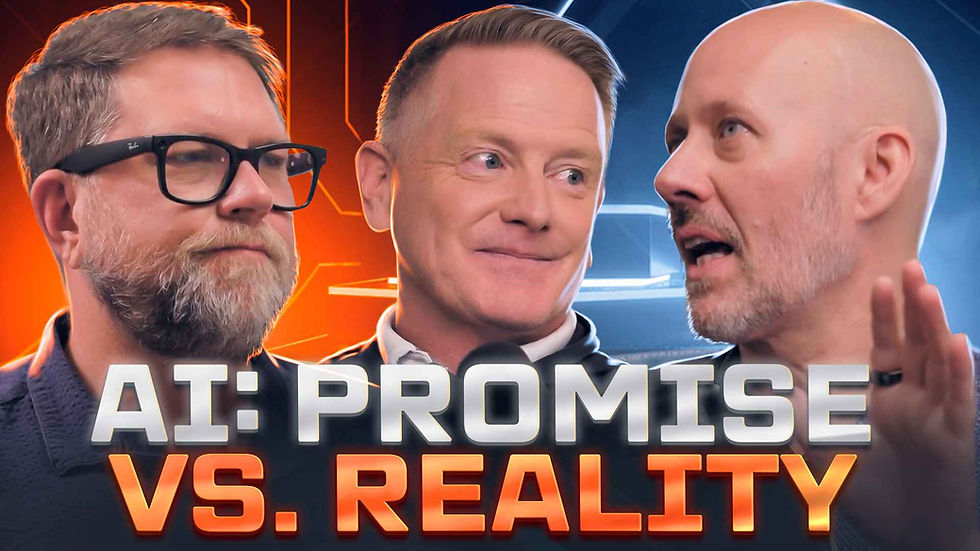
AI Won’t Save Recruiting with Matt Charney
It's more AI Sessions goodness. Yes, we know, everyone’s slapping “AI” on their product like it’s organic, gluten-free, farm-to-table software, but Matt Charney isn't buying it.
In this episode, Charney unloads on:
🤖 Why AI in recruiting = old tech in new lipstick
🪑 HR’s “seat at the table” (spoiler: it’s folding, cold, and in the back corner)
📉 Cutting-edge vendors handing your data to VCs like party favors
⏱️ Candidate rejection emails that arrive faster than DoorDash
It’s Vegas, it’s dangerous, and yes—North Korea somehow enters the AI chat.
👉 Press play before your AI “assistant” schedules another pointless meeting.
PODCAST TRANSCRIPTION
Joel Cheesman: Alright, let's do this. We are the Chad and Cheese podcast. I'm your co-host Joel Cheeseman. Joined as always, Chad Sowash is in the house. And this is the Sessions AI Frontline Series as we welcome Matt Charney, CMO at employer.com. Matt, welcome to HR's most dangerous podcast.
Matt Charney: Thank you very much. It's got a lot more cameras than I remembered.
Joel Cheesman: And they each put on 10 pounds, by the way.
Matt Charney: Right, that's great.
Joel Cheesman: Believe it or not, a lot of our listeners and viewers will not know who you are. Give us a quick elevator pitch on Matt and the organization that you work for.
Matt Charney: Sure. So, as I just said, my name is Matt Charney. That's at Matt Charney on Twitter, or X. And I have been in the space now for about 20 years, and mainly working, focusing on talent acquisition technologies. So I've run marketing for companies like Monster, Cornerstones, Smart Recruiters, and am now in charge of employer.com, which is a company that owns a bunch of different sub-brands, such as Bench Accounting, Bounty Jobs, and now Main Street Tax. So essentially, we're building a Google Workspace for small business.
Joel Cheesman: All the exciting acquisitions.
Matt Charney: Tax, accounting, all that fun stuff.
Joel Cheesman: Dude, fortunately we're not talking about taxes.
Chad Sowash: Boring makes money, that's all I've got to say. But what's not boring is AI. So...
Matt Charney: We can already agree to disagree.
Chad Sowash: That's fine, that's fine. It's not boring out in the space. Obviously, everybody's talking about it. Agentic is the big thing. But I think it's important for practitioners to understand that you just don't go out and buy AI and put it in your coffee in the morning, right? There's a lot of work to do around due diligence, etcetera etcetera. What are some of the biggest points that you've seen that are being overlooked by a lot of companies that are out there, a lot of practitioners who really, some of them can't even spell AI, for goodness sakes. What are they missing? What's the big miss?
Matt Charney: So for me, oftentimes, and this is canonically the case when people are purchasing HR technology, but I think it's really amped up with AI, and that is buying a solution in search of a problem. And so I think when you fundamentally look at it, it has to be, what problem am I trying to solve? Rather than everyone's using this new advanced technology, and I'm going to be left behind if I don't do it. So I would say a focus on process and process optimization efficiency with an orientation towards outcome. What do I want this to achieve? And most importantly, how am I going to demonstrate actual ROI when inevitably in this economy I'm called in to justify my spend?
Chad Sowash: So my wife loves when I say this because it sounds so cheesy. You'll love it too. Fall in love with the problem. Actually understand what your problem is.
Joel Cheesman: That's why she married you, right?
Chad Sowash: Yeah, exactly. Understand what the problem is. It seems like that's not the big key. Not to mention also, we're dealing with 20-year-old tech in many cases, right? So it's like there's more than likely some a ton of process optimization that needs to happen. So there has to be a process implosion. So using AI or agentic or what have you and trying to layer it into your current process methodology is probably not gonna work, right?
Matt Charney: Yeah. I mean, 100%. And the thing too is that a lot of what's being sold as AI, for example, like stack ranking resumes and matching, that's also technology that's been around for 20 years. So I think in the drive to look at AI solutions, I would also say what in my current stack actually has these automation capabilities in the first place, and you actually might be surprised because nothing here is new in terms of what's being sold. It's just being marketed and branded slightly differently than it used to be.
Chad Sowash: Right right. And who cares if it's AI, RPA, agent or whatever, just as long as you're getting the outcome that you're looking for.
Matt Charney: Exactly. Automation is automation. That's really what we're talking about when it comes to particularly agentic. Obviously, generative is a little bit different, but I don't think that recruitment probably has a lot of really solid use cases for generative AI.
Joel Cheesman: Now that we know you've been around a while, you mentioned Monster even, how does today's disruption compare to what you've seen in your career? 'Cause I had a hard time sort of paralleling what is going on now. The only thing that I could think of was the actual dot-com revolution. Am I overhyping that? Do you feel similarly? And my second part is, are we ready for it? And if not, how do we get ready for it?
Matt Charney: So, I think that we haven't seen a lot of change in this industry. It's been very status quo, and if anything, things have consolidated into a few major vendors and their ecosystems that plug in. And so I think that what we are looking at is, particularly when you look at the use cases and things that these AI solutions and technologies are being used to really deliver, what we're looking at is, to your point, legacy tech, an outdated code base, terrible and often negative net promoter scores, which has always been the case, and really seen more of a reaction to the frustration of their inabilities rather than an embrace of possibility when it comes to these AI products, I think. So, long story short, I think yes, it is the biggest change that I've seen, but that's only because it's disrupting the status quo to a certain extent.
Joel Cheesman: And I'm hearing you say we're not ready, if it's the biggest, 'cause most of the changes that haven't been as big were not quite ready yet. And can we get ready? 'Cause a lot of people are talking about the death of the profession. I mean, people like Kevin Wheeler, Tim Sackett, people that we know, are saying that the whole game is changing. Agree or disagree? 'Cause one of the things I've loved about you is we talk a lot of innovation on our show, a lot of pie in the sky, new stuff, QR codes and the like, right? And you've always been great about bringing things down and like, "Hey guys, it's still about job board, it's still about applicants." So, I'm curious your position on is it the end or are we hyping this thing just in a ridiculous manner?
Matt Charney: So, here's my caution on this, is, HR was in a very unique position, and I just want to point out I'm not politicizing anything, a couple of years ago to really put themselves into a strategic operator seat with the DEI imperative and the rise of that and really a focus and budget. Unfortunately, the backlash to that that we're starting seeing means that a lot of that capital has sort of been eroded. So, I think that in terms of being able to drive organizational change, that seat at the table that Shroom loves to talk about maybe have moved back a couple inches. So, I would say, as is often the case, HR likes to work in a silo. We talk about HR tech and the HR tech stack as if it exists independently. I promise that HR and recruiting are not the only functions who are having this conversation about AI and who are making significant capital investments in AI technologies. I think that the opportunity, rather than is the function going away or what's it gonna look like, with this new technology, because of its ease of integration, because of the fact that it improves with data and inputs and the business imperative of talent acquisition is to align with the business.
Matt Charney: Here's your chance to go actually work with those other LOBs and align technology stacks and get AI usage standardized and operationalized across the organization, and then that puts TA into a much better position to be able to be looking at the same numbers, being able to look at the same impacts, and being able to essentially standardize people information against business information.
Chad Sowash: So you're taking a look at the, obviously, the meteoric rise of ChatGPT and OpenAI, and then obviously Google has to come out with Gemini and then we've got Cloud and so on and so forth, but you've got all these competing models, but that's wonderful for organizations in our space because it seems like business people are using those large language models on a daily basis, so to be able to start getting them into the adoption phase, it just feels like it's happening much faster. Are you seeing the same thing in the market?
Matt Charney: Yeah, I think that you are seeing a lot of, in our space in particular, instances of essentially a vendor offering a white-labeled version of one of those commercially available LLMs. Here's the problem with that. There's so much compliance, moving targets there between intellectual property, between how they're handling and processing sensitive data, that if I were in the profession right now, I would definitely cease my use of some of these instances until they've been fully vetted by both my CISO and my CIO. I think that that is sort of a misstep, so those lessons are being learned elsewhere in the organization. To my earlier point, I would go and seek out those stakeholders and try to figure it out because I should not be adding to the risk profile of the company if I'm in HR. I should be mitigating it
Chad Sowash: It seems like most companies at this point, not just in HR, but in sales and customer service, it's almost afraid, like they're afraid that there's a bigger risk in losing to competition because competition's actually utilizing the large language models or the automation systems much better, right? And it almost feels like there's a bigger risk to lose out to competitors, or at least that's the narrative that's being pushed, to be able to drive adoption in this. What do you think about that?
Matt Charney: I think that that's a great way for sales to create urgency. However, I think that there are probably more downsides to being first to market than waiting and seeing, namely that if you're on the cutting edge, you often get cut. And you want to see a couple things. One, what mistakes are your competitors making? Two, is this something that I can fix independent of technology? 'Cause if I can, then that means I have some structural advantages that my competition doesn't have. And I think third and most importantly, is trying to see who has staying power among these vendors. Because what we're doing is we're giving a lot of very well-funded VC-backed startups keys to the kingdom in terms of our data and information without any sort of knowledge or foresight about are they gonna be acquired by a PE? Where's that data going to go afterwards? Look at TikTok as a basic example. What happens to all that now? And I think that if you're a business, there's a very real risk if that vendor goes under that all of your data is compromised or used in a way that you're not going to want.
Chad Sowash: Well the current administration, though, is pretty much telling all the other countries, hey, back off our AI countries, our AI companies. So it seems like they're making the statement that don't worry, break stuff. There's not that much risk while we're here. That's what it feels like. So it almost feels like companies feel like they can take that risk that you're advising not to take. Just because, I mean, again, it feels like the Wild West and like the administration's like it is the Wild West. Just go break stuff.
Matt Charney: I would argue that in terms of AI savvy, North Korea, in fact, is the most advanced nation in the world. We don't need to go into the reasons. But let's just say protectionism when it comes to integrated operating systems is a fool's errand, as is probably listening to this administration and making decisions long term based off of their short term policy objectives.
Chad Sowash: So you're taking a look at the, obviously, the meteoric rise of ChatGPT and OpenAI. And then obviously Google has to come out with Gemini and we've got Cloud and so on and so forth. But you've got all these competing models, but that's wonderful for organizations in our space because it seems like business people are using those large language models on a daily basis. So to be able to start getting them into the adoption phase, it just feels like it's happening much faster. Are you seeing the same thing in the market?
Matt Charney: Yeah, I think that you are seeing a lot of, in our space in particular, instances of essentially a vendor offering a white-labeled version of one of those commercially available LLMs. Here's the problem with that. There's so much compliance moving targets there between intellectual property, between how they're handling and processing sensitive data, that if I were in the profession right now, I would definitely cease my use of some of these instances until they've been fully vetted by both my CISO and my CIO. I think that that is sort of a misstep. So those lessons are being learned elsewhere in the organization. To my earlier point, I would go and seek out those stakeholders and try to figure it out because I should not be adding to the risk profile of the company if I'm in HR. I should be mitigating it.
Chad Sowash: It seems like most companies at this point, not just in HR, but in sales and customer service, it's almost afraid. They're afraid that there's a bigger risk in losing to competition because competition is actually utilizing the large language models or the automation systems much better. And it almost feels like there's a bigger risk to lose out to competitors, or at least that's the narrative that's being pushed, to be able to drive adoption in this. What do you think about that?
Matt Charney: I think that that's a great way for sales to create urgency. However, I think that there are probably more downsides to being first to market than waiting and seeing. Namely, that if you're on the cutting edge, you often get cut. And you want to see a couple things. One, what mistakes are your competitors making? Two, is this something that I can fix independent of technology? Because if I can, then that means I have some structural advantages that my competition doesn't have. And I think third and most importantly, is trying to see who has staying power among these vendors. Because what we're doing is we're giving a lot of very well-funded VC-backed startups keys to the kingdom in terms of our data and information without any sort of knowledge or foresight about, are they going to be acquired by a PE? Where's that data going to go afterwards? Look at TikTok as a basic example. What happens to all that now? And I think that if you're a business, there's a very real risk if that vendor goes under that all of your data is compromised or used in a way that you're not going to want.
Chad Sowash: The current administration, though, is pretty much telling all the other countries, hey, back off our AI companies. So it seems like they're making the statement that don't worry, break stuff. There's not that much risk while we're here. That's what it feels like. So it almost feels like companies feel like they can take that risk that you're advising not to take. Just because, again, it feels like the Wild West and the administration's like, it is the Wild West, just go break stuff.
Matt Charney: I would argue that in terms of AI savvy, North Korea, in fact, is the most advanced nation in the world. We don't need to go into the reasons, but let's just say protectionism when it comes to integrated operating systems is a fool's errand, as is probably listening to this administration and making decisions long-term based off of their short-term policy objectives.
Joel Cheeseman: And speaking of the administration, I want to touch on leadership real quickly. You said something around DEI that said leadership in HR took a couple steps back because of that issue. And one of the things that we hear consistently around AI is that AI is going to take all the grunt work out of our job, and we're going to be able to focus more on big picture vision, the business, having that seat at the table. And I can tell by your smirk, you're a little bit not so bullish on that. Talk about where that seat at the table is. How cold is it? How close is HR and recruiting to that conversation with the execs?
Matt Charney: Yeah. So the reason why I kind of smirked and why I brought up DEI is it was always, I think, readily obvious that given the multiple factors that go into that discipline and the significant money that we were investing in those initiatives, proving ROI is going to be very, very, very difficult, particularly when it comes to causation as opposed to correlation on outcome data. So for me, what this really, again, comes down to is your way to build credibility and seat at the table is to help your company basically make money more efficiently and at less cost. So you need to be aligned with, and I'm sorry to be the capitalist here, at the end of the day, if you ask your CEO, you can read all this post, what keeps you up at night? AI. That's not true. It's shareholder returns. And giving them value. And if you can't prove that you're doing that, you're never going to have strategic input. HR has had trouble, again, being able to prove that they are anything but a giant administrative cost center because of their inability to correlate with business outcomes. However, again, AI gives them the potential opportunity to be able to start showing how that works against the larger ecosystem and prove those outcomes in a way that we couldn't probably with any other generation of technology.
Joel Cheeseman: So you do agree that the tools today do offer a path to us getting a seat at the table?
Matt Charney: If we can get our heads around data, being able to understand how to interpret it, dashboard it, analyze it, and manage it, then yes. But I think data literacy and financial literacy, when it comes to just like FP&A and those sort of measures, be really, really, really important. So if we get the quantitative part, we've always been good at the qualitative, if we can make that business case, then I would agree with that.
Joel Cheeseman: And my perspective is we have so much legacy, so much duct tape upon duct tape that just laying an AI, on that is not going to achieve the results. I don't know, agree or disagree, but I feel like it's just another layer that's going to keep us in the same mud that we've been in for decades. How do we strip away that duct tape? Because I don't think there's an organization in the world today that's trying to do more with fewer people. And maybe fewer software is part of that as well. Your thoughts?
Matt Charney: Yeah, so I think that really you're correct. When it comes down to technologies like this, we're able to really consolidate the amount of tools that are being used and probably get a little bit more value out of them. You had a very long prelude to that question, and so I totally blanked out on the meat of it.
Joel Cheeseman: That's okay, and it's early in Las Vegas.
Matt Charney: It is early in Las Vegas.
Joel Cheeseman: I'll help you by saying I forgot the question. Let's see what Chad has to ask.
Chad Sowash: Yeah, so back to business outcomes. I think it's incredibly important that TA, HR, talent as a whole understands how they actually impact business, which means they have to actually go and make themselves a student of the business, which we haven't done. And we want to talk about strategic and building talent pipelines and life cycles and those types of things, but yet we're focusing on the day-to-day. How do we actually... And we've talked to plenty of companies that have started to slowly eke in little pieces of AI, that they see dramatic, because of being in 20-year-old tech, they see quick and easy impact on business, being able to actually redistribute individuals out to do other things.
Chad Sowash: So instead of scheduling interviews and those types of things, you don't have 100 people doing that anymore, which I thought was fucking crazy. But you can then redistribute those people, and then you can show that at least the first step of a business outcome to the C-suite and say, okay, we can make some really big changes if we start to retool how we do business.
Matt Charney: That's correct, and I would add to that, this is not a technological solution, but if you are creating efficiencies to open up time in your schedule for meaningful impact, then what I think it is imperative to your point that recruiters do is not say, oh, I have more time to talk to candidates, or I have more time to get to know this or that about recruiting, or look at more technologies. Spend that time actually having as much face-to-face interactions with both the hiring managers [0:09:49.5] ____ your stakeholders to understand what their needs are, what they're looking for, what that business is about, and with the frontline workers who you're gonna be recruiting their colleagues. I think that once that trust is established, maybe then you can have a much more meaningful conversation about technology, but it will just be looked at as largely transactional if you're only able to deliver candidates cover letters and say, make a decision.
Matt Charney: And so if you were just a messenger, yeah, you are gonna be eliminated by AI or automation or whatever because we're moving towards a self-service model, the only way to prevent that, again, nothing with technology, trust and expertise, because the one advantage recruiters do have in an organization is they are the internal subject matter experts about the one thing that everyone cares about, which is building and advancing their career.
Matt Charney: Unilaterally, everyone in a company cares about that. I would leverage that fact and start getting my face out there because you as a person [0:10:50.3] ____ much harder to replace. A general recruiter who is filling recs, very easy, and that's probably been replaceable with technology that's existed for 20 years now.
Chad Sowash: So the Shopify CEO has said, and it's just a different way to go at the question because AI is in it, but pretty much says, hey, look, you're going to have to prove to me when you need to open a new rec that AI can't do that job. And that's literally just challenging the hiring manager and the departments to say, this is why I need those resources. And the only difference, because we've been doing this for years, the only difference is they're throwing AI into it, saying, what can AI do? So what's your thought, especially coming from the CEO down to HR and the hiring managers? This to me feels like a gelling moment for both of those two. What do you think about that? And do you think it's going to be something that we see from more CEOs moving down the road?
Matt Charney: I think that throwing AI in is a good... I think it's an exercise that every organization goes through. We're still using, people complain like job descriptions don't describe Jobs, right?
Chad Sowash: Yes.
Matt Charney: And the reason why is because we're using outdated compensation documents that are put in there with requirements for essentially like leveling and banding purposes.
Matt Charney: So I think to go through and say, what do these jobs do? And do we actually need this position is probably a really good exercise regardless of how you look at it. But if you're looking at AI through that filter, I think that you also need to make it as, like a determination, can AI do the job is one, but AI by particularly generative AI always is going to be average. Its output is going to be the median of everyone's input. So if you want quality, that's a variable that I would look for because particularly in positions like marketing or sales or other kind of high touch, more ambiguous sorts of roles, quality is something that I would look at. Maybe AI could replace, but I want to be better in the competition.
Chad Sowash: Well, isn't it even smarter to break down the job description as in tasks? Because yes, that job in itself is literally just a sequence of tasks that are happening. What tasks within that job could actually be done by AI, which could prospectively free up that individual to do more in different business impactful areas.
Matt Charney: I think that yes, looking at any jobs task, again, no matter how you slice and dice it, a really good activity. I would add though that you have to frame in terms of what is this job's intended contribution to the larger organization or the impact. Because again, tasks may or may not align with that. And if they don't, then that's something that AI can't fix. You're going to have to as an HR department.
Joel Cheesman: In light of tasks, I know that you have an opinion on sort of hiring for skills and not degrees and the trend that is, you know, really hot right now is...
Chad Sowash: How do we finally do that?
Joel Cheesman: Taking the tasks that you were doing that are now AI tasks, and what are you going to do above and beyond what you're doing now and upskilling those people and re-educating, etc. Where are you on hiring for skill versus degree? Because I know you have some strong opinions around hiring for a degree versus upskilling and skills.
Matt Charney: So a couple of things. I think tasks and skills are very different topics. I'm going to talk about skills, right? And from a skills perspective, as long as we're still using fundamental technologies that require job descriptions and resumes, those are based off of a totally different paradigm than skills. And there's generally no way to extract those foundational documents and be able to find skills. But I would challenge any organization if I were to ask how many people in your company have photoshop-like abilities, they wouldn't be able to tell you. So companies don't have an extent inventory of the skills of their current employees, much less being able to project out and screen for those in a larger population. So without modeling what those skills look like within an organization, because the application is going to be very different company to company, and without knowing who you already have internally and who you can upskill with what skills, it is just another way to sell technology that people don't really need. But if they would have gone to college, they might have learned that. So to your point on degrees, I'm not an educational elitist, but here's what I do think. There's a high enough rate of college graduates in this country where we're able to fill jobs with them.
Matt Charney: I think that is it necessary for a lot of jobs? No. But at the same time, and I say this from a place of privilege, it demonstrates that you were able to play the game and show up and after four years walk away with a degree. That to me means that you are ready to show up to work, to do the tasks that are given to you, and to be able to essentially follow the rules of a larger institution. So what your degree in, where you go, those don't matter, but that's really the only proof of concept in my mind for somebody who's entering the workforce without any actual experience.
Chad Sowash: Joel only asks about fraternity. That's all he cares about.
Joel Cheesman: And sports.
Matt Charney: We can talk about that all day.
Chad Sowash: Because you know the skills that come with that.
Joel Cheesman: My reply is always, show me a Fortune 500 C-suite without degrees. It's impossible to find. So I know upskilling and giving people new skills is very important, but at a certain level, it still matters. It may not one day, but today I think it still does. But I know you had a strong opinion on that, so I wanted you to clarify.
Chad Sowash: And if those companies, and it's funny because we do talk about skills, and it's different from company to company on the types of tasks. Let's say, for instance, from a FedEx or a UPS. They're two entirely different companies. Do the same kind of stuff, but they're two entirely different companies, how they carry out logistics, so on and so forth. So the skills might be incredibly different in some cases, but if they don't have that skills taxonomy or whatever the hell you want to call it, then they really don't know what they're looking for in the first place. So how many companies today, and when working and talking to a lot of companies, none of them have these skills warehouses at all. So why are we even talking about skills when the companies don't know the skills that they currently have in place?
Matt Charney: It's a great question. And to your point though, FedEx and UPS, the fundamental difference between those two companies' workforces, UPS is almost entirely unionized. FedEx is not. It uses contractors and carriers. So if I were those organizations, I would be more focused on labor relations than how can I build a whiz-bang AI product. So I think again, to your point, look at the workforce.
Joel Cheesman: And the negotiations require them to focus on the people and not the technology.
Matt Charney: 100%.
Joel Cheesman: Or balance them both.
Matt Charney: So yeah, one of those organizations will have an advantage of being able to look at technology, but is it what their business is going to need on the other side? No. So I think again, that is the alignment exercise. But if you're wasting your time on skills, you are missing an opportunity right now to really be able to get a place at building your company's future and having a chance to impact that from an HR perspective.
Chad Sowash: It also feels like a full-time job in some areas because tech is moving so fast. To be able to keep up with the skills index per se is not going to be easy in your company, not to mention also being able to translate that to academia to be able to say, look, these are the types of skills that we need from your cohort that's coming out this season.
Matt Charney: Right, like and academia would say, the ability to write an APA style bibliography, which I would say probably not in any workforce situation.
Chad Sowash: No.
Matt Charney: But I look at five, six years ago, and here's the problem with skills. We're telling everyone, you are set for life. Go to a coding boot camp, quit your job, learn how to code, and you're guaranteed to have an immediate play. And we've seen AI has replaced that entire cadre of coders that we were so excited about.
Chad Sowash: But is that a problem? Because now we don't have junior coders. And those junior coders one day are going to be senior coders. But we are, I mean, we're hollowing out the bottom of the development for talent. I mean, it's crazy.
Matt Charney: We are doing that to a certain degree. But what I think is actually really interesting, if you look at that, it's a very American phenomenon. Particularly in developing nations, you're starting to actually see a bell curve where middle management is starting to be stripped out. They're hiring huge university cohorts at multinationals, particularly in APAC. And so I'm seeing that model, which is kind of where those opportunities are being shifted, actually just be offshored from a junior perspective more than eliminated or having any sort of upcoming talent shortage.
Joel Cheesman: Conversational AI, I know that you have some strong opinions on the experience of the candidate and how conversational AI plays into that. We're seeing some signs of a pushback on machines versus real humans. Where does this all play out?
Matt Charney: So it's fascinating to me. So I'll use candidate experience as an example. And for years, the best practice was you need to let every candidate know their status as soon as they're rejected from the process, right? You have to give them the news. And now you're hearing candidates like, well, I applied for a job at 9:01 and 9:03, I got a thanks but no thanks letter. They didn't take the time to read my resume. So I think it's interesting that we're seeing this like pushback on it. So is there a happy medium? I really don't know. But when we look at the research, statistically, and there have been a few of these studies done now, it seems that candidates and job seekers have no issues with AI until the interview process. And that's where I'm starting to get concerned as I'm seeing a lot of technologies that are AI or automation slated going towards interviews. And that's really, to me, a terrible use case and where it's all going to fall apart because candidates want to be able to ask real questions of real people. They want that kind of, you know, very personalized experience. And on the other side, there's something that you really can't, you know, work for, which is fit and chemistry.
Chad Sowash: Yeah.
Matt Charney: And that's something that no algorithm is really probably ever going to effectively capture in the same way that an interview would. So I would say everything up to that point, look at as an AI use case, everything after that needs to be heavily personalized to make sure that you're able to not only convert them, but also end up onboarding them.
Joel Cheesman: Got it. Well, Matt, thanks for hanging out with us today. Enjoy the rest of your time in Vegas. And for The Chad and Cheese Podcast, this has been the AI Sessions, The Frontline Series. I'm Joel Cheesman. That's Chad Sowash. Find out more about us at chadcheese.com. We out.
Chad Sowash: We out.


Comments