


The Future of Work and Staffing in an AI Era
Bots, Burnout, and The Future of Work
Would you trust an autonomous robot with a straight razor near your throat? If your answer is an emphatic "hell no," congratulations: you already understand the existential panic currently gripping the global labor market.
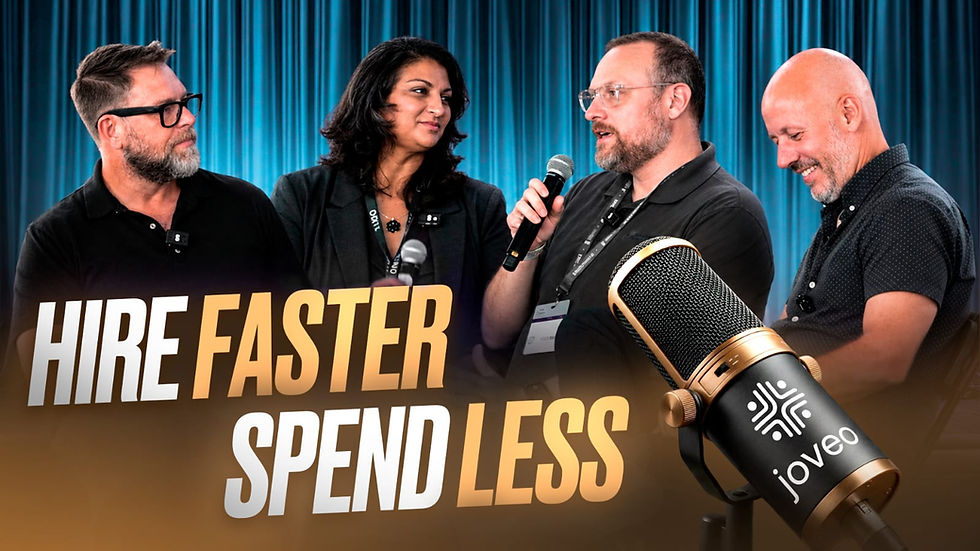
Broadcasting live from Amsterdam, podcast co-hosts Joel Cheesman and Chad Sowash wrangle four European HR heavyweights to tackle the burning workplace crises keeping everyone awake at night:
Rika Coppens, CEO, House of HR
Chiara Riondino Head of Future of Work & Youth Employment at the European Commission
Minna Melleri, Executive Director, World Employment Confederation
Glenn Bloxham-Mundy, Global Accounts Leader, LinkedIn
Hit play to find out what happens when hyper-efficient candidate bots spend all day courting automated recruiter bots, and how a show recorded in the Netherlands managed to avoid talking about actual cheese.
PODCAST TRANSCRIPTION
Chad Sowash: How many of you felt like you wanted to be that guinea pig for the shaving robot? Anyone? Anyone?
Joel Cheesman: Can you imagine the anxiety that that guy was going through? And you know—
Chad Sowash: I want to see the manscaping robot! I want to see that guy.
Joel Cheesman: You're going to be the guinea pig for that one, yes.
Chad Sowash: What's up, Amsterdam!
Joel Cheesman: Aw, yeah! It's the podcast that dude at the Red Light District warned you about. We are the Chad & Cheese Podcast. I'm your co-host, Joel Cheesman. He's Chad Sowash.
Chad Sowash: Hello.
Joel Cheesman: We are live at the e-Recruitment Congress in Amsterdam!
Chad Sowash: In the Muziekgebouw!
Joel Cheesman: All right, we have four very special guests—
Chad Sowash: Yeah.
Joel Cheesman: —for our show today.
Chad Sowash: Let's go.
Joel Cheesman: So on the show, we do what we call a Twitter bio, you can call it an elevator pitch, it's just a quick introduction to you. I think we kind of know Rika, but some of our listeners, this is a live show, won't know you. So give us a little bit about you, and then we'll go down the line here before we get into the Q&A.
Rika Coppens: Okay, very good. So I'm Rika Coppens, I'm the CEO of House of HR. We deliver all kinds of HR services across Europe, and I think one of our biggest quirks or what we're known for is that all of our employees are called Happy Rebels, because we want to innovate, we want to do new and cool stuff, and whenever everyone zigs, we want to zag.
Joel Cheesman: Love it.
Chad Sowash: Get that. Woohoo! HR... HR Happy Rebels. Get that.
Joel Cheesman: They cheered more for that than for us.
Chad Sowash: Get that. That's kind of bullshit.
Joel Cheesman: All right, next?
Chiara Riondino: Hi, Chiara. I'm responsible for future of work and youth employment at European Commission, and I'm super excited to be here, and already learned a lot in the first keynote, and so really excited to be on.
Joel Cheesman: It's pronounced Chiara?
Chiara Riondino: Chiara, like with a K.
Joel Cheesman: Got it. I learn so much when I come to Europe.
Minna Melleri: Hi, everyone. I'm Minna. I'm executive director of World Employment Confederation. So we are the global voice of the workforce solutions industry globally since 59 years.
Joel Cheesman: Wow.
Minna Melleri: And we have members like the House of HR, the big workforce solutions companies globally, and also a great network of national federations across the world.
Joel Cheesman: They put the LinkedIn guy closer to me because you're a little bit scary, Minna, so... Friendly space. Great, great to have you here, Glenn.
Glenn Bloxham-Mundy: Great to be here, thank you. Been at LinkedIn for 10 years, currently leading our global accounts, some of which are probably in the room today. And previously spent a lot of time with our slightly smaller businesses as well, so enterprise clients, too.
Joel Cheesman: We appreciate you being here. Very courageous. Very courageous.
Chad Sowash: Excellent. So again, a big round of applause for Steven and that presentation. Wasn't that awesome? Wasn't that awesome? Yeah, great job, man. Great job. Now, how many of you felt like you wanted to be that guinea pig for the shaving robot? Anyone? Anyone?
Joel Cheesman: Can you imagine the anxiety that that guy was going through? And you know—
Chad Sowash: I want to see the manscaping robot! I want to see that guy.
Joel Cheesman: You're going to be the guinea pig for that one, yes.
Chad Sowash: But Gallup's new poll just came out, and worker anxiety went up seven points—27%, right? And I see that that growth of anxiety really falls on our shoulders, being the leaders of this industry in many different areas. What have we gotten wrong, and how can we turn that around so they are not anxious? I'm going—you're closest to me, Rika. You first.
Rika Coppens: Okay. Workers' anxiety, yeah, it's a big topic, of course. There was even a number in Belgian newspapers indeed that one in three employees has the risk of having a burnout. So it's one in three, which is an incredible number.
Chad Sowash: Imagine if you work at Samsung!
Rika Coppens: Yeah. But it's true. I think our perception of work is no longer the way it used to be. And one of the things I like to say is that it's not work-life, but work-private balance, because you don't stop breathing when you start working, luckily. So yeah, it's a question of how can we make work more attractive again as employers. And indeed, like Steven was saying, I think the work connectivity and being more human even at work is a very important one.
I was this weekend—I was at my rowing club, and I was attending the bar, so I was drawing the beers and things like that. And there was someone in front of the bar, because you know when you're at the bar, you have people talking to you all the time, especially when they drink a little. And one of the guys was like, "Ha, I realized that work for me, it's a personal thing. Colleagues can never be friends, and I'm basically continuing to do my job because it pays well." And I was like, "Oh my god, if this has to be the way you look at work, then why don't you evolve? Why don't you move?" And I think this is one of the things in Europe that we need to change is like we've built golden cages for people at their jobs, because they get higher salaries when they get older, they have all these advantages. And he was talking in a similar way about his wife, like she's never going to change her job because in a new job, she will never have the perks that she has now.
And so people get stuck in roles, they get stuck in their job, they don't learn new stuff, and that's when you start to overthink stuff and you hate your work, and that's where anxiety and burnouts come from, in my opinion.
Joel Cheesman: Yeah. And there's AI that comes... Chiara works with a lot of young people, and I hear the young people are really stressed out as well. What's your take on entry-level jobs and the youth finding employment?
Chiara Riondino: Well, I was struck by—I was listening to one of your previous podcasts, and you were quoting a Gallup survey...
Joel Cheesman: Look at her sucking up.
Chiara Riondino: ...saying that people distrust, especially young people, distrust companies that use AI, and it's more than 70% of young people that do so. And I was struck, because actually we have a bit of different data. We have a survey that is called the Eurobarometer when we ask citizens, "What do you think of this? What do you think of that?" And actually, the trust in AI, well, the positive views in AI were actually more than 60%. And then there was a little addition: provided that it's regulated and that there are safeguards.
Chad Sowash: Mhm.
Chiara Riondino: So I think maybe the difference is that people responding to what you think about AI also think, "Oh, but is this trustworthy? Can I trust? Is this safe?" And okay, our Eurobarometer was before all agents started going rogue and breaking into places, so maybe now the figure would be different. But I think that the element of trust, of knowing what will happen, is really important.
And for young people and entry-level jobs, I think we are in the worst possible moment now, because companies are pressured to have efficiencies, and so they are pressured to make the best possible use of AI. And when you go to your shareholders and you say, "Well, I'm going to fire a lot of people because I can use AI," like we've seen also earlier, then you're going to look good. But then at the same time, you have the same message that is going also to a broader audience, and then people start saying, "Well, I don't want to work for you because you're going to fire me."
And so we are in a moment where companies think that they can do without the previous level of entry-level jobs, and young people don't have the new skills that are required for the jobs, because what is requested is that you actually are a little manager already. And I think that we need to build the space for young people to make mistakes safely...
Chad Sowash: Mhm.
Chiara Riondino: ...and whether this is at a certain point at the end of their education or throughout their education, actually, where they already arrive with a different profile on the labor market, or where this is employers that take the responsibility to say, "Okay, I'm not going to need you to do this kind of repetitive work, but I still need you to be in this a bit senior level in two or three years now." We need to find that space.
I think now we are unprepared, because schools and universities are not prepared for the new requirements, and employers are not ready to accept that they need to take a bit of this on themselves. So I'm confident that things will improve, but we are not in the ideal moment right now.
Chad Sowash: Minna, the word "regulation" popped up there, and I know you've been working very hard on that side.
Joel Cheesman: That only took three minutes in Europe.
Chad Sowash: There we go. Oh, you saw me, I had to get in on that real quick. So the EU AI Act, the quality jobs, all those different things. There are gaps, there are areas where obviously things need to be tightened up. Technology is moving way faster than regulation, even though regulation is moving much faster in the EU than it is in the US. What have you seen from a gap standpoint, and how can we bridge some of those gaps?
Minna Melleri: Well, it is indeed very difficult for regulation to move as fast as technology. And I think some of the anxiety that you referred to in the workplace in general comes from the fact that there's this huge focus in the past years on just the technology piece.
Chad Sowash: Mhm.
Minna Melleri: "Oh, this bot can do that, and AI is now taking over this task." So humans have in a way been left aside, and it's then everyone hyping around that technology. And I think it's a healthy turn now that both in terms of regulation as well as the workplace we want to create for the future, we are refocusing on the human.
And I think that's really at least right now where a lot of the regulations are looking at: how can—and tech companies and those tech solutions providers should also look at how these technologies can empower the humans and be our superpower. That's how we can actually do more interesting work at entry level, because the keynote, Steven, he said, you know, humans have been treated like robots. Well, this is our opportunity to move away from that and to make sure that it is serving our humanity, that we are humans in command or humans, yeah, leading, in the lead, and not in the loop, not just observers.
And I agree that as employers, we really have to make an effort to make sure that the young generations also get these opportunities to enter the labor market, to get those experiences, because how can they get those practical applications and experiences with AI if they don't have the job? How can they learn all the soft skills that are now also so important?
Chad Sowash: Mhm.
Minna Melleri: So and it's not only for the young people, it's for our organizations 10, 15, 20 years from now.
So on the regulatory side, I think there's a good—I mean, in Europe, Europe is a very special place in the sense that we really look at safeguarding and not letting technology lead us to a place where it's out of control. And I think now it's also in other parts of the world, those concerns have been raised and are very vocal. But it is a complex task, and that's where we, as the HR solutions industry, we want to bring our practical applications in the world of work and work together with regulators in how the scaling of these technologies in the workplace are maybe changing also the level of risk which was identified earlier.
And then, of course, as an industry, we are responsible users of AI. Most companies out there want to use these technologies in a responsible and ethical way. So we have our own codes for the ethical use at company level, but also at confederation level, where we want to reassure the employees as well that they are experimenting with these technologies in a safe and compliant environment.
Joel Cheesman: Got it. And pivoting a little bit to the private sector, Glenn. It's not just young people with entry-level jobs. We're hearing a lot of stories about ageism with 40s very old now, apparently, and keeping up with technology is tough. I know with products like LinkedIn Learning and the data that you guys see, what's your perspective on people learning new skills, what kind of things LinkedIn is doing to provide a platform where people can learn AI and things that are in demand in the workforce?
Glenn Bloxham-Mundy: So I think the skills half-life is diminishing really quickly. I feel like the best skill you can go into the workforce with at the moment as a young person is just adaptability, the ability to relearn and unlearn. So I think one of the biggest challenges that people will face and businesses, and the people in the room play a big part, is truly being able to, you know, hire through skills, being able to map a workforce and understand what is adjacent, what could be transferable, and what could be built internally.
So we, you know, we, along with a lot of other platforms, have tools that allow them to do that through taxonomies. So can you truthfully say across our workforce, "Here's the skills we have. These are the fastest growing. These are the ones that are most in demand with our clients, and we're going to build towards that." And then can you help upskill people along the way? Can you facilitate it and make that medium for them as easy and enjoyable as possible? I think that then becomes really prosperous and enjoyable when you have a workforce that's adaptable, that's constantly learning, and in doing so creates prosperity for those companies and their clients.
Joel Cheesman: Any trends you're seeing on the upskilling front? Is it a broad demographic of folks, just if you have any numbers, or...?
Glenn Bloxham-Mundy: I've got some stats here, but I probably don't know off the top of my head well enough to misquote them, but within the talent world, the fastest-growing title within the talent world is the talent strategist, more so than anything else, which I think is indicative of where we are. You know, that move into the higher value, less operational elements of the role, I think that's quite interesting.
Joel Cheesman: Cuz scheduling doesn't really...
Glenn Bloxham-Mundy: It's not paying as much.
Joel Cheesman: ...pay the bills anymore. That's for sure.
Chad Sowash: So, instead of leaning so hard on the private sector, what are we seeing from either government or even from organizations themselves starting, much like IKEA, to identify the opportunities that they have in-house or organizations also helping them identify, "Look, there's going to be this huge shift. Instead of pushing your workforce out, these individuals who you've had working for you for years, how do you reskill them?" So, anybody seeing that in the landscape at all or participating in this type of reskilling outside of kind of like the private sector?
Glenn Bloxham-Mundy: I would just say from Steven's point before, you saw it with the example of, was it the call center, and that element? We saw a huge amount of that during COVID, where we had...
Chad Sowash: You talking about Klarna?
Glenn Bloxham-Mundy: Pardon?
Chad Sowash: Klarna? Klarna?
Glenn Bloxham-Mundy: No, it was the one where they had—it was IKEA.
Chad Sowash: IKEA, yeah.
Glenn Bloxham-Mundy: Yeah. And they repurposed those people, retrained them, and then used them for interior design. But we see that across a lot of businesses. There's a lot of change and disruption at the moment. The traditional role is being, like we see it in our business, has shifted a lot. And I think the biggest and best of what they're doing is they're mapping that really effectively and confidently, and then facilitating that for them. You know, knowing that you've got a cohort in your business that culturally fits, is, you know, got relationships and history within the business, you know, that doesn't necessarily need to be lost. It needs to be upskilled and used elsewhere.
Chad Sowash: But for the most part, most companies have no clue, and they have no strategy behind that. So, Rika, you know, you have many clients who need that kind of direction. Are you and your peers in the industry really focused on that type of identification and respectively development?
Rika Coppens: Yeah, I think constantly looking at reskilling and what can be done there is obviously—it's not new. It's something that we've been discussing already for quite a while, even before we were discussing AI, and even before AI was there, we were digitalizing a lot of our processes, and we were always saying digital will not take your job away. And I think this is always the fear of people. We said, "It will increase the coffee time." That was what we said internally in order to have more time for coffees with your candidates in our case, so that we can have true conversations or have interviews with our customers.
And in a way, what we need to do is with the use of technology, with the use of AI or whatever we call it, is to understand our customers better. And that was also in Steven's presentation with the car, with the Mafioso and Will Smith, Fresh Prince, yeah. So indeed, it's understanding what your customers need, and then we need to move up higher in that value chain. And that requires indeed different skills of our people, because they need to understand and they need to have those conversations. They need to know how to have those conversations: "What is your real problem? It's not that you're missing maybe a person, it's maybe a whole department that is not working the way it should."
So it does mean that our interviewing needs to get better, and in order to do that, we need to diminish the time and the administrative burden, let's automate the boring stuff, and that's what we're working on. But understanding true customer needs, I think that's where the real thing is, and the same with our candidates. We need to get closer to our candidates so we can anticipate what kind of next job they need.
And as I was saying internally in House of HR, we try to constantly kill ourselves, and we were talking about this yesterday. We created Nowjobs when we said "kill Accent," and now in a way we created House of AI in order to also think about how could we within House of HR have a completely new recruiting process that has nothing to do with the old one, or where we deliver more value to both customers and candidates. And we started from frustrations. So that's how we try to continue to be creative, because creativity is—let's be honest, AI is still reproducing what once was done by a human being, because that's where they get their knowledge. So trying to think out of the box, getting that creativity flowing, I think that's where we can make the true difference. So opening that creativity in your companies is so crucial, and allowing people to make mistakes—you mentioned it as well—that's also a crucial thing to get forward and to know what's happening. So we encourage our customers to do the same, but not all of them are there yet.
Joel Cheesman: You know, Rika, you mentioned getting closer to your candidates. And I think the elephant in the room, and certainly when Chad and I talk to a lot of TA people, and this is an agent conference, is that we post a job, we have a ton of perfect candidates apply to that job, we shut the job off, we interview the perfect candidates largely through our agents, realize that they're not real people or not really qualified for the job, then we have to go back to the drawing board, we have to go source our ATS, we have to go to LinkedIn and source candidates.
So when you say get closer to the candidate, it seems like we're in an environment where we're not getting closer to the candidate. We're fighting application bots with recruiting bots and then figuring out on the other side. So I'm curious anyone's thoughts just in general. There seems to be a real breakdown where the real humans feel like, "How do I win in this environment? A job is posted and in 24 hours it's gone. I don't even have time to apply. How can I compete in that? What can we do as an industry, government regulation? How do we give the people a leg up in this environment?" Because I think they feel like there's no hope in getting employment and getting a fair shot at a job.
Glenn Bloxham-Mundy: Personally, I came back from New York last week at our flagship event, and we had lots of leaders from some of the biggest companies in the world, and pretty much every single conversation came down to that eventually. That's the most pressing thing on CEOs of the largest recruitment companies in the world right now is just verification, trust, identity, and it's a huge problem. And I think some people don't realize how big a problem it is.
When you see some of the new technology that's out there, we witnessed a client of ours talking about the lengths that people will go to now. It is staggering. So I think at least how we're thinking about it, there's a really big role to play in verification and being able to, you know, prove "I am that person. I have those skills. I went to that university. I've done that job." And it sounds basic, but it is a complex problem and something that I think is key. If you can do that, I think you can begin to solve the rest of it.
Joel Cheesman: And you're partnered with CLEAR, for example. A lot of people probably familiar with that company. So you're engaging third parties. It feels to me like, and I'm curious cuz you can post a job on LinkedIn, but also more and more people are going to LinkedIn, they're saying it's called quiet hiring, right? Like, we're not going to post a job, we're just going to go find the person. Are you guys doing anything not only around verification, but encouraging job seekers to make a more robust profile? Cuz one of the things we talked about on the show this week was that the people that are on there with robust profiles are people that are really actively looking for a job or really anxious. The people who are perfect don't even have "About" sections. They just throw their stuff up. How do you get them engaged to where LinkedIn becomes a more robust system to find real people that have these real skills?
Glenn Bloxham-Mundy: Couldn't agree more. Firstly, there's a lot of data behind the data. So even the person with no profile data on the platform, you go on, you see maybe a job title from 5 years ago and a blank personal statement on there, there is often data behind that. So I think LinkedIn's got north of 2 billion CVs now on the platform. So behind that profile, if you're using the right tools, you can access that data. So you can still search and find the most recent place of work or the skills behind that role, etc.
But the other parts on the candidate side, and we're really members-first in our thinking. Every decision has to start with, "Can we encourage more of our members to use the platform and see value in it?" If we don't, there's no clients, there's no business without that. And so we've put a lot of time and effort into modernizing the platform and helping job seekers. So trying to, exactly what you said there, fill out their profile, complete it, add additional data, do a training course that creates richer data and allows them to see better opportunities, and that kind of coaching element of it, I think that will also help.
Joel Cheesman: Yeah. Rika, I know you have some opinions on the flood of automated candidates that are hitting job...
Rika Coppens: Yeah, it is indeed something that we need to work on, and we will fight agents with agents. But I do think that the connection again, and trying to be more proactive in getting candidates in the case of temporary workers, to get them to your office, to have the real conversations still.
If I look at the flow, and this is also where the European AI Act is helping, is that we cannot have AI bots decide whether someone goes through or not. So there still needs to be a human intervening to say, "Yes, this person can move on to the next stage," or is accepted for the role. And that's where the human has to intervene, but that requires that connectivity.
So it is a lot more work, and indeed we do need to fight agents with agents, because otherwise you cannot handle the massive amount of applications that you get. But after that, you definitely need the human to intervene.
Chad Sowash: Is it that we're just pretty much in the R&D segment of the—because we're pretty early into this. Yes, it's moving incredibly fast. We've got slop all over the place. And I think that's one of the biggest problems right now. We see not just the—
Joel Cheesman: And they're one of the biggest problems.
Chad Sowash: —huge amount of applications that are coming in, right? But we have huge platforms like Indeed who allow multiple resumes, and those resumes are all tailored by, guess what? AI. And they all look the same. Every huge Fortune 500 company that we talk to say all these resumes are looking the same and we're getting bombarded, right? LinkedIn is trying to do their best in being able to help create content, but they've also been crowned the king of AI slop. 62% of all the big platforms that are out there, LinkedIn had 62% of that. And that's because they wanted to try to be on the forefront. Are we moving too fast? Are we moving too fast, Chiara?
Chiara Riondino: I don't think we're moving too fast. I think that everything is moving fast, so you need to move with it. And this is true both for employers and for people who are looking for a job. You cannot afford not to use the tools, otherwise you are out of the market on both sides.
But maybe what you were mentioning earlier, that a vacancy is open and shut very fast, and then you have to go back to the drawing board, maybe that is where we could introduce a little bit of lag time, where you could have some more qualitative check.
And for me, sometimes I'm also a recruiter, and it was fascinating that I received an application from somebody who had been responsible for drawing and negotiating the Platform Work Directive, and this is something that my team does, and I had never heard of this specific person. So it's inevitable that you will always need to go back and really talk to the people.
And this is something that we see also from young people especially. Even when we have job interviews and we offer the opportunity of doing this online, people want to come. They want to see you. They want to know who you are, and if they are coming to work for you, they want to see who they're going to spend their time with. And it's the same in terms of how we work. We have flexibility to work from home, but especially young people, they are in the office every day. Maybe they're there half day.
So what we're seeing now, and I think it's normal, you always have this paradox in polarization. You go from one extreme to the other. So first everything had to be done in person, then after COVID everything has to be done online, and now we are coming back in the middle. And this is what I think is going to happen also with recruitment, because now people are afraid that they're not going to have a job, so they're applying to everything. But they don't want to work for everyone. We saw it. I really very much agree with Steven, they don't want to just have a job. They want a job where they can feel valued, where they can contribute, where they can see having a career. And you, as an employer, you don't want anybody who just ticks some boxes. You want somebody who is loyal, who will bring good atmosphere, good idea, good creativity. And all of this you cannot capture with an algorithm. So I think we're just oscillating between the two poles, and we are going to find together a middle.
Joel Cheesman: I think when you talk about the challenge for the employers, also figuring out in its early days, Chad, I know you mentioned that, is we're learning that this AI thing is a black box, and what's really going on in there? In the United States, we have a court case. We have the Fair Credit Act, which basically says if you don't give me a loan as a bank, you have to tell me why.
Chad Sowash: Transparency.
Joel Cheesman: Because there was a time where you're the wrong color, the wrong sex, the wrong whatever. And I feel like we're like that now with jobs. "Why didn't I get the job?" "Well, the algorithm." You know, you got screened out. I think that's a real problem. I think that Europe has a golden opportunity to be at the forefront of protecting the consumer, if you will, as the job seeker. Minna, you're nodding your head. Do you have any insight into what you would like to see in terms of protecting the job seeker and letting more transparency in the AI and the algorithm? Because I think there's a real sense of despair with job seekers going, "I didn't get this job, I got screened out."
Chad Sowash: Opportunity.
Joel Cheesman: "Why?"
Chad Sowash: If you get that right.
Joel Cheesman: "Why?"
Minna Melleri: Yeah, and I mean in Europe, there is this labor market activation topic right now. We do have a big proportion of the citizens who need to be introduced to the labor market, and we need to look at that as a toolbox, at all the ways in which these employees can be brought in. And in terms of our industry, we want to make sure that we capture them. And AI has not, for instance, yet had a huge impact on informality and the NEETs, for instance. So the young people not in education or training are still out there somewhere as the hidden NEETs that are not necessarily on those platforms that the algorithms are busy capturing.
So there is that element of making sure that we look at labor markets and all the different players in the ecosystem that can play their role. And I think for the HR services industry, it's really a moment to be that strategic advisor. So it's not just the transaction between matching, which happens indeed online, and when it happens at scale, it loses the value, as we discussed, but it's really helping organizations, so on the employer side, to plan their workforce in this new agentic era where it's actually getting more complex.
And I think we have really to work together to look at what does it mean for management, what does it mean for all those processes. Yes, you can automate the tasks, but you still need to orchestrate and bring everything together. And that's a completely new way of managing the workplace and managing the work that needs to get done. So it is a huge shift.
For regulation, it's also the policy side of encouraging. It's not just saying, "These are the rules," but it's also encouraging new ways of making the economic activity more dynamic. And we have that rigid labor market in Europe, which is a problem for our competitiveness if you look at the global level as well.
Rika Coppens: Yeah, I do agree that our labor market in Europe is too rigid, and I think we need to free it up, and there needs to be more freedom there. And it starts in Europe, and obviously then it needs to be translated in local legislation, so that people move around more, that they look for more opportunities. Because as I was saying, we have too many people stuck in golden cages, and that will obviously allow them to look for new roles, new jobs, and be more open to technology and whatever exists in the market.
And we can no longer be like we were 40, 50 years ago where people were applying for a job with the intention to stay there for 40 years. That has changed completely, and that's not new either. That started already 20 years ago, 10 years ago. But we need to work on that in Europe to also accommodate that, and to make sure that the market is more free. There is enough work for everyone even with technology evolving. Yes, there will be jobs disappearing, but there will be a lot of new jobs coming.
And as to what AI can do, it's not all bad, right? We have introduced these chatbots indeed that interview candidates in the first get-go with some yes/no questions, and based on that we decide, and they are very objective. So in a way, you can give very good feedback to someone why they were not actually selected for a certain job. And that is good, because they now can get emails saying why they were not selected, which in the past is, "Oh, you were not withheld for the job. We will put you in our database and maybe next time we'll contact you." That was a generic email that was pushed out. And now with AI, we have the opportunity to personalize those emails much more and to go more in detail and in depth and actually give more advice. So it's not all bad. I think AI is also bringing a lot of advantages to workers.
Chad Sowash: Well, there is a lot of advantages, but you take a look at the efficiencies that are actually happening today. We're seeing that with many organizations that are cutting work time for recruiters by 30% or what have you, which give them more of that coffee time that you talked about.
Rika Coppens: Yeah.
Chad Sowash: No, but from the staffing side of the house, how do you bring that economic value to be able to keep your clients there? Because if they're using this tech, like, "I don't need staffing anymore." What is the economic value as we move forward in this agentic session?
Rika Coppens: I think that's the million-dollar question. It's one of the things that we were discussing two weeks ago. I was at Microsoft in Seattle, and I was asking the same question: like, how do we make sure that as a company and as an intermediary, which we all are, we can keep that value with us and it's not actually going through customers? And the answer is probably we won't be able to keep it at the intermediary level.
The ones that move faster than the other ones will be able to keep some of that value and efficiency in the company, so it is a question of adapting as fast as you can. And then probably you will get efficiency in your company, and it will also allow you to grow and maybe buy some businesses and consolidate, because scale will matter with AI. So that's what I will see happening in the industry is that there will be more consolidation going forward given this technology shift. And then part of that value will move to customers.
And the only way to keep that value in your company is what I was saying in the beginning: we need to move up higher in the value chain. We need to understand our customers better. We need to deliver more services. It cannot just be like, "I'm going to interview a candidate, and then place him in your company," because this is something with the technology they can do themselves as well.
Chad Sowash: Minna, you're shaking your head. You've got some thoughts.
Minna Melleri: I'm nodding.
Chad Sowash: Agreeing with Rika.
Minna Melleri: It's the fact indeed that the customer is no longer paying for the effort, it's for the outcomes. And this is not the only industry. If we would be in a conference of lawyers in law firms, they're also very nervous about their billable hours, because that model of the past just doesn't work anymore. And customers are not ready to pay for the number of hours, they want the outcome.
And so I was just nodding to Rika's point that that's what I was saying about being a strategic workforce solutions partner, so an advisor, and looking at the full spectrum of, especially for big companies, but also smaller ones, how they can adjust and stay agile in this fast-moving world with all the new technology that is being introduced constantly. We're not done now. It's going to continue, and we will need to readjust again in the workplace, in our processes.
Coming back to the human-centricity and that human side and combining it, I don't think it's so much about just delegating to those agents or delegating to the AI technology. It's really staying close and making sure that those decisions make sense from a human point of view, because that's ultimately who the employees are, that's what the customers are, because we are still in a human society.
Joel Cheesman: All right, starting with Glenn, I want each of you to get your crystal ball out. We're going to teleport a year from today. What's the most important issue in TA that we're talking about a year from now?
Minna Melleri: I'm really curious about this youth population, what we will see, because they need those opportunities, and I think it's becoming a societal and a social topic as well. So I'm curious in how far we've come in that conversation, in coming up with the new types of value work for them to allow them to be part of our labor market and play that role.
Joel Cheesman: Okay. You ready?
Glenn Bloxham-Mundy: Sure.
Joel Cheesman: Okay, go.
Glenn Bloxham-Mundy: I'll say databases less important than ever before, and you'll see more clients have had access to...
Joel Cheesman: For a company that has a big database, that's a bold statement. Please say more.
Glenn Bloxham-Mundy: But recruitment databases are—I think they're going to adapt a lot in the coming years with integrations for verification, and I think there's going to be a huge shift there that we haven't seen.
Joel Cheesman: Are we talking ATS database?
Glenn Bloxham-Mundy: Yeah, ATS in particular.
Joel Cheesman: So that the importance of the ATS will diminish?
Glenn Bloxham-Mundy: Yeah, I think when you talk about everyone having access, and this piece, but this has been the case for years. Companies in this room have not sold their database for years.
Joel Cheesman: I think Chad might have...
Chad Sowash: So you're talking about more of like—something that we've talked about before is like different types of candidate passports. So a candidate doesn't really reside in just a single database. Their information belongs to them, but they could choose to actually provide it to Company A or LinkedIn or what have you. Is that what you're talking about, and their verification?
Glenn Bloxham-Mundy: I mean it more from the client side. I mean it more from the recruitment agency side. I think that they haven't been making all their money from candidate access. They've been making it from all these higher-value services that are really being pronounced right now. And you're seeing where companies are succeeding there, is they can provide higher value.
Rika Coppens: I'm very happy to hear this, because in Belgium we launched the initiative WorkID.
Chad Sowash: Uh-huh.
Rika Coppens: So it's an initiative that we launched as an industry, so under the umbrella of Federgon, the labor union so to speak of the employers. And we're connected to public databases, and the signature is an e-signature with itsme—the Belgians here know it—so it's linked to your passport, and with that you can apply. So it also avoids people applying to a job when they use WorkID that they don't exist, because actually those people need to exist, because it's linked to your national passport and so on and so on. And we want this to be the unique truth in order to apply for a job. So maybe there is a possibility at some time we'll link with LinkedIn and WorkID, so who knows?
Chad Sowash: And the candidate owns that, just like they—
Rika Coppens: Yes, the candidate owns their data, so it's not a recruitment database. No one can start—so the initiative continues to be with the candidate. There's even sliders in there that were—actually it's one of the features that we want to develop is that they can choose which data they share with which employer. And at each time they can see with which employer they have shared their data, and they can actually switch it off again. So the candidate remains the owner of their own data, and that's how we've set up WorkID in order to have one single source of truth, and also avoid mistakes for the agencies.
Joel Cheesman: I think we're going to give Rika the last word on that one. Guys, give it up for Glenn, Minna, Chiara, and Rika! We are the Chad & Cheese Podcast. You can learn more at chadcheese.com or listen on your favorite podcast platform of choice. We out!
Chad Sowash: Out!
Announcer: Thank you for listening to, what's it called? A podcast. The Chad, the Cheese, brilliant. They talk about recruiting, they talk about technology, but most of all they talk about nothing. Just a lot of shout-outs of people you don't even know, and yet you're listening, it's incredible. And not one word about cheese. Not one. Cheddar, blue, nacho, pepper jack, Swiss, so many cheeses, and not one word. So weird. Anywho, be sure to subscribe today on iTunes, Spotify, Google Play, or wherever you listen to your podcasts. That way you won't miss an episode. And while you're at it, visit www.chadcheese.com. Just don't expect to find any recipes for grilled cheese. It's so weird. We out.


Comments